

On January 9 the Washington Post published a remarkable editorial titled, “Jack Smith would have blown a hole in the First Amendment.” Discussing Smith’s closed-door testimony before the House Judiciary Committee in December, the Post claimed the hearing revealed Smith was “clinging to flawed legal theories.” It argued that Smith’s case against Trump for seeking to overturn the 2020 election would have violated Trump’s First Amendment rights and that the special counsel had sought to criminalize Trump’s political speech.
But it’s the editorial board that is pushing flawed legal theories. The piece is at best misleading, and at worst simply dishonest. It endorses a bizarre view of the First Amendment and misrepresents the facts of Smith’s prosecution.
As long-time Sidebars readers know, I was a contributing columnist at the Post for a number of years. I asked them if they would consider a column from me rebutting their editorial. They declined, but said they would accept a letter to the Editor. They did publish my letter, which I appreciate. But there are strict space limitations on letters to the Editor and there is much more to say.
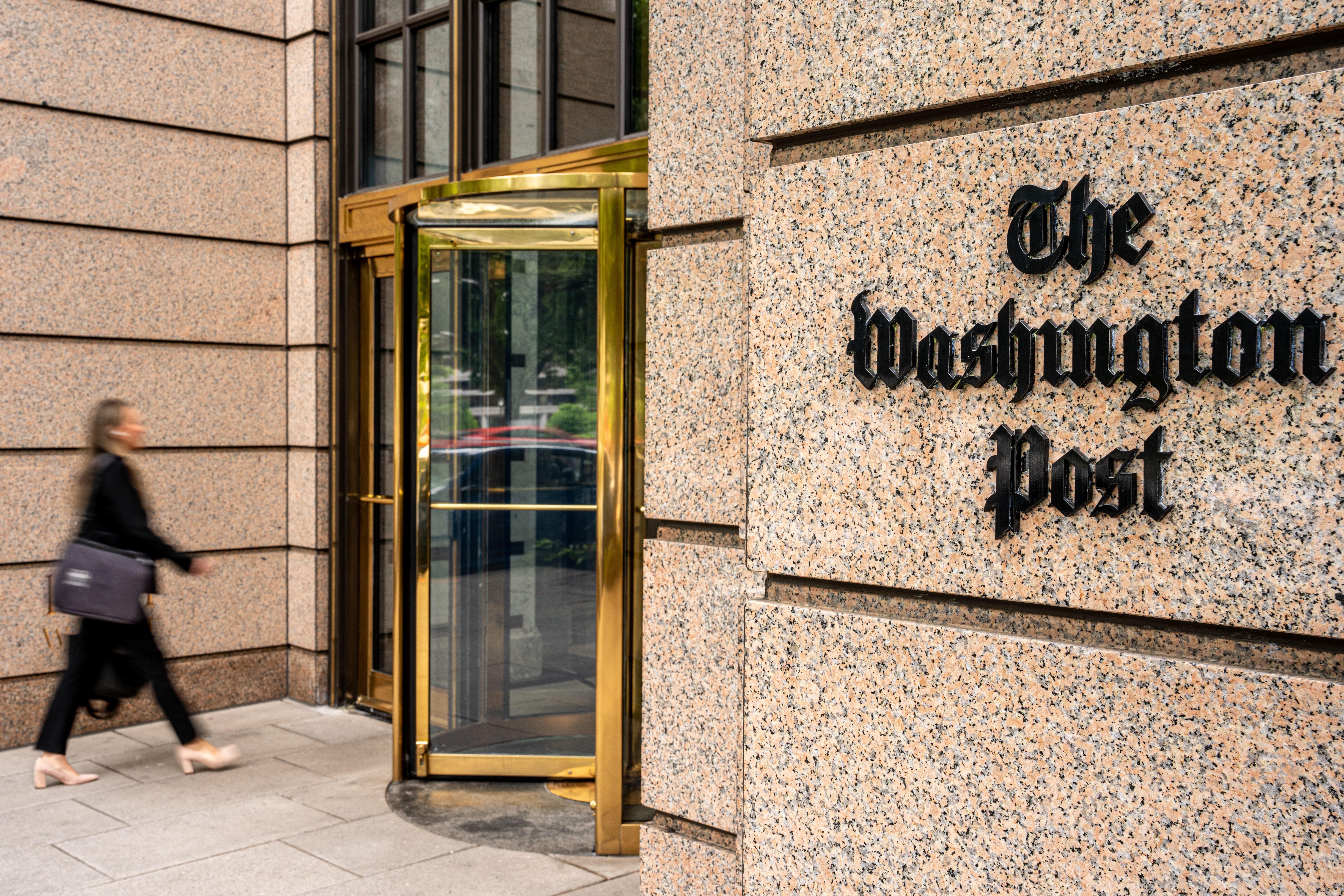
The Washington Post building in Washington, D.C. (Andrew Harnik/Getty Images)
As the Post editorial noted, Republicans on the Committee pressed Smith on whether his prosecution infringed Trump’s First Amendment rights. At one point the Republican counsel asked Smith, “The President’s statements that he believed the election was rife with fraud, those certainly are statements that are protected by the First Amendment, correct?”
Smith responded:
Absolutely not. If they are made to target a lawful government function and they are made with knowing falsity, no, they are not. That was my point about fraud not being protected by the First Amendment.
According to the Post, this was a “bold claim” by Smith. The editorial board wrote:
Political speech — including speech about elections, no matter how odious — is strongly protected by the First Amendment. It’s not unusual for politicians to take factual liberties. The main check on such misdirection is public scrutiny, not criminal prosecution.
But this wasn’t a “bold” claim at all. Smith was exactly right. His indictment and legal theories were sound under both criminal and constitutional law.
Criminal Speech Is Not Protected
The Post editorial goes off the rails right from the start:
Smith’s August 2023 Trump indictment focused on Trump’s repeated claims that the 2020 election was stolen in the run-up to the Capitol riot on Jan. 6, 2021. Put simply, the indictment accused Trump of lying so pervasively about the election that he committed criminal fraud.
That’s not putting it simply, it’s putting it falsely. The charges were not based on Trump’s “lying pervasively” about the election or taking a few “factual liberties” in his public statements. (By the way, didn’t “factual liberties” used to be called just “lies?”) And the indictment wasn’t based on Trump’s “claims,” it was based on his actions.
Smith’s indictment made this distinction clear right up front in the third paragraph: “The Defendant had a right, like every American, to speak publicly about the election and even to claim, falsely, that there had been outcome-determinative fraud during the election and that he had won.” In other words, Trump was entitled to engage in political speech and even to lie about election fraud. He was not prosecuted for that speech.
Trump was prosecuted for conspiracy to defraud the United States, conspiracy to obstruct justice, obstruction of justice, and conspiracy to deprive citizens of their voting rights. He used his lies about the election as tools to further those conspiracies and to persuade others to act in furtherance of those conspiracies. Under well-established law, that speech was not constitutionally protected.
Trump and his co-conspirators used the lies about the stolen election and voter fraud to try to convince state officials to overturn their election results. They used them to persuade groups of phony state electors to execute false documents claiming Trump had won their state and send those documents to Washington. Trump used the lies to pressure Mike Pence and try to persuade him to discard lawful ballots and throw the election to Trump.

Trump also used those lies to create what the indictment called an “intense national atmosphere of mistrust and anger,” culminating in his summoned supporters coming to Washington and rioting at the Capitol on January 6. He failed to do anything to try to stop that riot for more than three hours, but did send a Tweet that inflamed the crowd and endangered Pence’s life — taking advantage of the riot and fanning the flames in furtherance of the conspiracies to overturn the election results.
It’s true that these crimes involved speech. Many crimes do. The con man who convinces his victims to put their money in a phony investment scheme uses speech to do it, but prosecuting him and introducing evidence of that speech is not unconstitutional. Fraud, perjury, extortion, bribery, threats, and other crimes routinely involve talking. But the Supreme Court has repeatedly recognized that the First Amendment does not protect speech that is used as an instrument of a crime.
A Conspiracy to Defraud the Government
In response to Smith’s point that speech in furtherance of a fraud is not protected, the editorial conceded that “of course fraud is a crime.” But it argued that Smith’s fraud theory was flawed because fraud “almost always involves dissembling for money, not political advantage.”
(As another aside, don’t you love the characterization of Trump’s efforts to overturn the election as merely seeking “political advantage?”)
This too is legally incorrect. For more than 100 years the Supreme Court has recognized that a conspiracy to defraud the government under 18 U.S.C. 371, the charge used in Smith’s indictment, does not required any monetary loss to the government.
Conspiracy to defraud the United States requires only a conspiracy to obstruct or defeat a lawful government function through deceitful or corrupt means. Trump was charged with conspiring to obstruct and defeat the Congressional vote count proceeding through the fake electors, pressure on state officials, lies about voter fraud, and other dishonest schemes. That makes out a conspiracy to defraud the United States under section 371. The facts of this case were unprecedented, but Smith’s legal theory was grounded in a century of precedent.
If you are interested in more detail about this criminal charge, I wrote about it here and here in connection with the Robert Mueller special counsel investigation. Mueller also used conspiracy to defraud the United States to charge the Russians who sought to influence the 2016 election. They were charged with conspiring to defeat the lawful functions of the Federal Election Commission, State Department, and Department of Justice — all without proof of any monetary loss.
The Judge Agreed with Smith
The editorial notably failed to acknowledge that the parties litigated these First Amendment claims before the trial judge, and she ruled against Trump. Rejecting Trump’s motion to dismiss, Judge Chutkan found that the indictment “properly alleges [Trump’s] statements were made in furtherance of a criminal scheme” and thus were not constitutionally protected.
If you’re going to paint Smith as a rogue prosecutor with no regard for constitutional rights, it might be, you know, fair and balanced to point out that a federal district judge agreed with Smith, and disagreed with Trump, on these very issues.
The Gag Order Was Appropriate
The editorial also faulted Smith for standing by his decision to seek a gag order that would prevent Trump from attacking witnesses, prosecutors, court personnel, or the criminal process. It claimed Smith had sought to “muzzle” Trump in the midst of his presidential campaign. But Trump had a well-documented habit of viciously and publicly attacking anyone involved in his prosecution. The trial judge found that a gag order was required to prevent these attacks from jeopardizing the safety of witnesses and court personnel and potentially influencing the jury pool.
Gag orders raise tricky constitutional issues. But the free speech rights of criminal defendants are more limited than those of members of the general public, and judges have the right and obligation to protect the integrity of their proceedings. The court of appeals trimmed the gag order around the edges, primarily by saying Trump had to be free to criticize Smith himself. But it left most of the gag order in place, agreeing with the trial judge that Trump’s attacks risked jeopardizing the fairness of the trial.
This was not a unique case; the judge in Trump’s New York state prosecution also imposed a gag order on Trump in response to his similar attacks, and the New York appeals court upheld that order.
Even under the D.C. gag order, Trump was still free to claim he was innocent and that he was a victim of political prosecution by the Biden administration – he was hardly “muzzled.” Smith cannot be faulted for trying to protect his witnesses and staff from the dangers posed by Trump’s repeated attacks and for trying to ensure that the trial proceedings were untainted by Trump’s social media rants.
When multiple trial and appellate judges agree that gag orders are an appropriate response to Trump’s tirades, it’s hard to paint Smith as a rogue prosecutor with no regard for the First Amendment.
Democracy Dies in Darkness
The editorial says Smith “apparently has no regrets about this heavy-handed approach, even though it failed legally and probably helped Trump win the 2024 election.”
Hold on — in what sense did Smith’s approach “fail legally?” His charges were upheld by the judge, as was the bulk of his proposed gag order. The case had to be dismissed when Trump won re-election, but that had nothing to do with its legal merits. I have little doubt that, had the voters not chosen to put Trump back in office, he would have been convicted at trial.
As for possibly helping Trump win the election, Smith’s job as a prosecutor was to follow the facts and the law without regard to the political ramifications – a proposition with which you’d expect the Post to agree.
The editorial concludes by saying, “Any honest accounting of the Trump legal saga needs to reckon with” the arguments in the editorial. As I’ve said many times, irony is dead in Washington: the city’s paper of record is calling for an “honest accounting” in an editorial that can be fairly accused of being dishonest. It parrots Trump’s failed legal arguments and political talking points and presents them as self-evident truths, while misrepresenting the nature of the case against him.
It’s sad to see what has happened at the Post since Trump’s re-election. During the first Trump administration the paper adopted the somewhat pretentious slogan, “Democracy Dies in Darkness.” But recently, under Jeff Bezos’ ownership and their new editorial leadership, rather than acting as a beacon the opinion pages frequently sound like a MAGA mouthpiece. These days the slogan often feels less like a warning and more like a plan of action.
Trump has been trying to rewrite the history of January 6 and the 2020 election for years. (The most recent example is an outrageous official White House website that is filled with nothing but proven lies and Trump propaganda.) It’s distressing to see the Post contributing to that effort by falsely casting Trump as the victim of an overzealous prosecutor who did not respect the Constitution.
PS: Jack Smith reportedly will testify before the House Judiciary Committee again on January 22, this time in a public hearing. Expect Republican questions about the First Amendment to figure prominently and to echo the flawed arguments made by the Post.
Thank you! I wish there were more people like you.
It’s sad to see what’s happened to the Post. The fine paper that was a shining beacon of truth is now a purveyor of MAGA propaganda. I’m very glad I canceled my subscription.