

Last week the Chief Judge for the D.C. federal district court threw out two grand jury subpoenas issued to the Federal Reserve by the D.C. U.S. Attorney’s Office. The subpoenas were part of a criminal investigation of Fed Chair Jerome Powell that was launched by Jeanine Pirro, the U.S. Attorney for the District of Columbia. Chief Judge James Boasberg found that the subpoenas were issued for the improper purpose of pressuring Powell and the Fed to give in to Trump’s repeated demands that they reduce interest rates.
Grand juries are given a great deal of leeway to conduct their investigations and it’s rare for a judge to reject their subpoenas. But for Pirro, this is just the latest in a long string of failures, any one of which would have been considered remarkable in any prior administration. Pirro has been doing her best to abuse the power of her office to punish Trump’s enemies and pursue his political agenda. Fortunately, she’s finding that those pesky guardrails built into our criminal justice system are doing an effective job of stopping her.
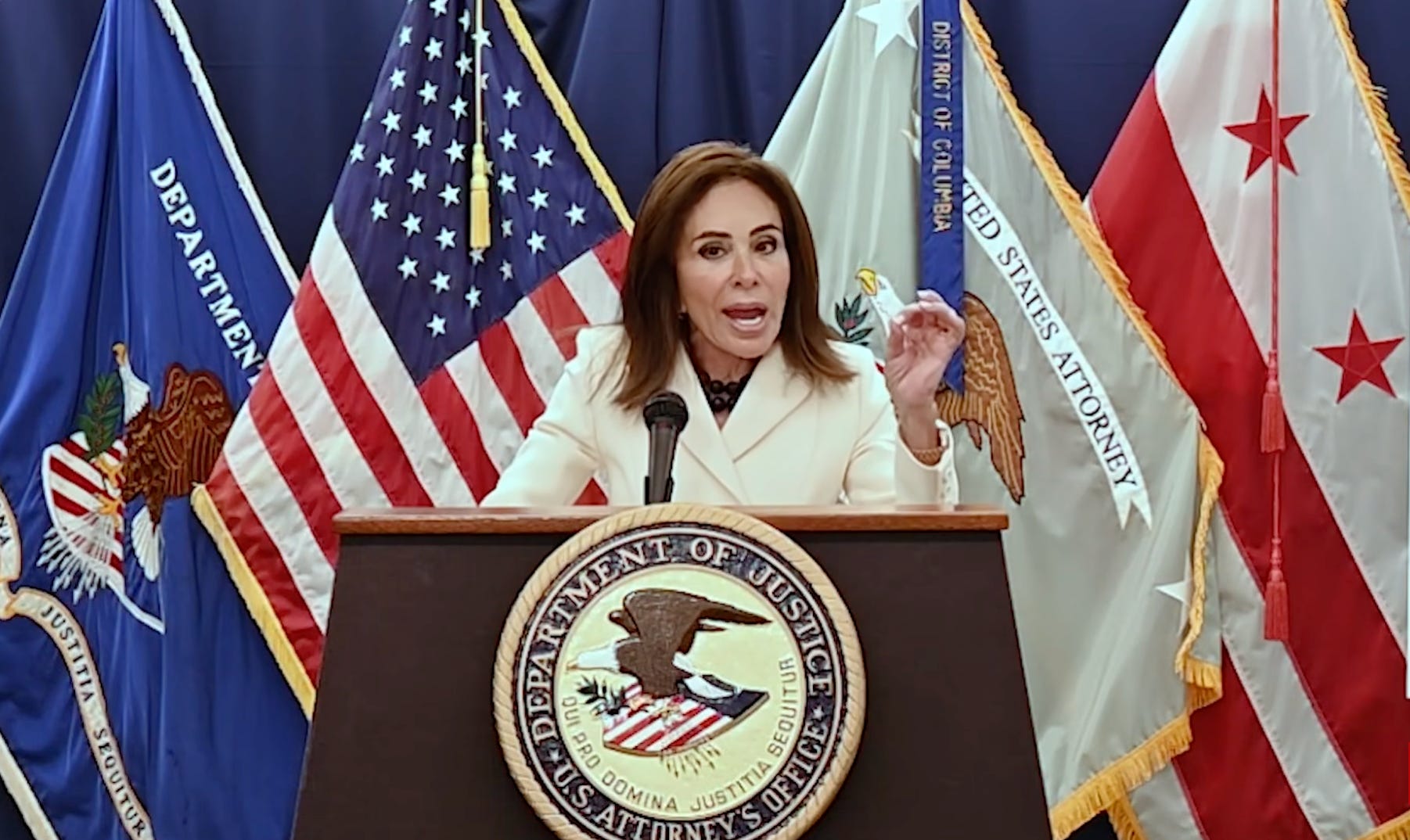
Jeanine Pirro at press conference following Boasberg’s decision
The Powell Investigation
As Boasberg noted, monetary policy creates a tension between what might help a president politically and what would be in the best long-term interests of the country. A cut in interest rates can lead to a short-term economic boom, benefiting the president in power. But that same cut could lead to inflation that hurts the overall economy but doesn’t show up until later – after the next election, for example.
To shield the economy from such politically-motivated manipulations, Congress created the Federal Reserve to set target interest rates for the country and manage inflation. The Fed is independent and members of its Board of Governors may be removed only for cause. As a result, the president and his administration have no direct role in setting interest rates.
Trump has been raging against Jerome Powell and the Fed for years. He has repeatedly attacked and insulted Powell and berated him and the Fed for not lowering interest rates. Trump has said he wants Powell “gone” and has threatened to fire him, even though he does not have that authority. (A number of Trump’s attacks are collected in Boasberg’s opinion.)
Despite Trump’s repeated demands and attacks, the Fed and Powell have held firm in pursuing the interest rate policy they believe is in the best interests of the overall economy. So the Trump administration decided to criminally investigate Powell to amp up the pressure. Last July William Pulte, the Director of the Federal Housing Finance Agency, posted on X that Congress should investigate Powell over his Congressional testimony about renovations of some Federal Reserve buildings that have been going on for several years and have faced significant cost overruns. Pulte noted that any misconduct could give Trump a basis to remove Powell for cause.
(Pulte, as the head of the FHFA, has no official role in criminal prosecutions. But he’s a Trump loyalist who has developed a specialty in conjuring up bogus criminal allegations against Trump’s opponents, including claims of “mortgage fraud” by Senator Adam Schiff, New York Attorney General Letitia James, and Fed Governor Lisa Cook. He is now under investigation for allegedly abusing the powers of his office by investigating and making such criminal referrals.)
Trump quickly shared Pulte’s allegations on social media. The White House press secretary announced the administration was looking into Powell’s testimony. Shortly thereafter, Pirro’s office opened a grand jury investigation of Powell and issued two subpoenas to the Fed for documents related to the renovations and Powell’s testimony.
The Motion to Quash
Rather than turn over the subpoenaed documents, the Fed filed a motion in federal district court to quash, or throw out, the subpoenas. In D.C. such motions related to grand jury investigations are automatically assigned to the Chief Judge.
Federal grand juries are allowed to paint with a very broad brush. There is no legal threshold (such as probable cause) that must be met before a prosecutor may begin a grand jury investigation. As the Supreme Court has held, a grand jury “can investigate merely on suspicion that the law is being violated, or even just because it wants assurance that it is not.”
Given this standard, it’s quite rare for a party to successfully challenge a grand jury subpoena – at least in an investigation where prosecutors are acting in good faith. But although the power to investigate is broad, the power to issue any given grand jury subpoena is not unlimited. Under the federal rules a subpoena may be challenged if compliance would be “unreasonable or oppressive.”
As Boasberg noted, that standard may be met if a court finds that the “sole or dominant” purpose of a subpoena is improper. An improper purpose, in turn, could include using a subpoena to conduct a baseless “fishing expedition,” to maliciously target or harass an individual, to punish or intimidate a political opponent, or to pressure an independent agency to bend to the president’s will.
Boasberg found that essentially all of these improper purposes were behind these subpoenas. Tracing the history of Trump’s attacks on Powell and the initiation of this investigation, he concluded: “A mountain of evidence suggests that the dominant purpose [of the subpoenas] is to harass Powell to pressure him to lower rates.”
The Chief Judge went on:
In sum, the President spent years essentially asking if no one will rid him of this troublesome Fed Chair. He then suggested a specific line of investigation into him, which had been proposed by a political appointee with no role in law enforcement, who hinted that it could be a way to remove Powell. The President’s appointed prosecutor promptly complied. Those facts strongly imply that this investigation was launched for an improper purpose, as were the resulting subpoenas.
On the other side of the ledger, Boasberg noted that the government had offered virtually no legitimate justification for the subpoenas or evidence that the investigation was being conducted in good faith. The government said that the significant cost overruns raised the “specter of fraud.” But Boasberg noted that cost overruns are common in a multi-year project and that the Fed’s independent Inspector General had been monitoring the renovations and raised no concerns.
As for Powell’s testimony, the Government claimed it “contained possible discrepancies” and was “possibly problematic” (talk about hedging!) but provided no details. The judge also noted that most members of the Committee before which Powell testified, including the Republican Chairman and members of both parties, have said publicly they don’t think Powell did anything wrong.
Boasberg also noted he had offered the government the opportunity to submit evidence ex parte (only to the judge) in support of the subpoenas, in case it did not want to show all its cards for legitimate investigative reasons. Given that opportunity, he said, the government failed to provide any information. “The Court is thus left with no credible reason,” Boasberg wrote, “to think that the Government is investigating suspicious facts as opposed to targeting a disfavored official.”
The judge concluded:
Searching for any reason to suspect that Powell might have lied to Congress, the only one the Court can descry is that he testified at a hearing. The Government might as well investigate him for mail fraud because someone once saw him send a letter.
Accordingly, given the overwhelming evidence of an improper purpose and the government’s complete failure to provide a convincing investigative rationale, the judge granted the extraordinary remedy of quashing the subpoenas:
When the evidence of improper motive is so strong and the justifications for these subpoenas are so tenuous, it is hard to see the renovations and testimony as anything other than a convenient pretext for launching a criminal investigation that the Government launched for another, unstated purpose: pressuring Powell to knuckle under. . . . The Court will therefore grant the Motion to Quash.
What Happens Next
Pirro held a combative press conference in response to the decision. She predictably attacked the highly-regarded Boasberg as an “activist” judge and falsely claimed he had improperly cloaked Powell with criminal immunity.
Pirro’s claim that Boasberg acted outside the law is, of course, nonsense. The Federal Rules specifically recognize that a grand jury subpoena may be challenged and rejected. Boasberg performed the quintessential judicial function of applying the facts before him to the “unreasonable or oppressive” legal standard and found that the Fed had met its burden in challenging the subpoenas. Given the government’s complete failure to provide a convincing rationale for the investigation, Boasberg’s ruling seems eminently reasonable.
Pirro has vowed to appeal the decision. But when it comes to pursuing this case, it’s not clear she is on the same page as the president. Powell’s term as the Fed Chair is up in May, and Trump has nominated former Fed governor Kevin Warsh to replace him. Warsh is largely expected to be more compliant in response to Trump’s demands about interest rates.
But Republican Senator Thom Tillis, who is on the Senate Banking Committee (and who is not running for re-election), has attacked the investigation of Powell as a politically-motivated effort to influence the Fed. Tillis has repeatedly vowed he will not vote to confirm Warsh or any other new Trump nominee to the Fed until the criminal investigation of Powell is dropped. Without his vote, Republicans can’t get the nomination out of committee.
Boasberg’s ruling could have given Pirro’s office an off ramp to close the investigation and clear the way for Warsh’s confirmation while blaming the judge. Instead she plans to appeal, which could easily take six months to a year or more. Assuming Tillis sticks to his guns, that will effectively prevent Trump from having his new Fed Chair confirmed.
I won’t be surprised if Pirro gets the word from her superiors that if she really wants to please the boss, she should take this opportunity as an excuse to close the case and walk away. We shall see.
Pirro’s Abysmal Track Record
This decision is a stinging rebuke to Pirro, but she should be getting used to that by now. She’s had a remarkable string of failures in her improper efforts to use her office to punish Trump’s political opponents and pursue his political goals. The following are some highlights, but are far from an exhaustive list:
Congressional video investigation: After six Members of Congress made a video reminding members of the Armed Forces that they should not follow unlawful orders, Trump blasted it as sedition:

Pirro promptly launched a criminal investigation. The alleged crime was never specified, and for good reason: the video was an accurate statement of the law under the Uniform Code of Military Justice, not to mention protected speech under the First Amendment and the Speech or Debate clause.
A federal grand jury unanimously rejected Pirro’s proposed indictment, finding that prosecutors did not even meet the low threshold of probable cause. A grand jury rejecting a proposed indictment is extremely rare; having it do so unanimously is unheard of.
Two weeks later, Pirro’s office decided to drop the case.

Flag burning case: Just last week, Pirro’s office dropped the charges against a veteran who was prosecuted for burning an American flag outside the White House. The veteran, Jay Carey, was protesting a Trump executive order that urged the Justice Department to find ways to prosecute those who burned the flag. (The Supreme Court has held that flag burning is protected by the First Amendment.)
Facing a court deadline to respond to Carey’s claims that he was a victim of a vindictive prosecution for exercising his First Amendment rights, Pirro’s office quietly dropped the case with no explanation.
Subway Sandwich guy: In a widely-publicized case, Pirro’s office absurdly sought to bring felony assault charges against Sean Dunn, who threw a Subway sandwich at a Customs and Border Patrol agent to protest Trump’s federal law enforcement surge in Washington, D.C. The grand jury refused to indict Dunn for the felony offense. Pirro’s office then charged him with a misdemeanor, which does not require grand jury approval. At his misdemeanor trial, the jury found him not guilty.
Sidney Reid case: In another case stemming from protests of Trump’s surge of federal officers into D.C., Pirro’s office sought to charge Reid with felony assault after her minor scuffle with an agent let to some abrasions on the agent’s hand. Three separate grand juries rejected the felony charges. Once again, Pirro then charged the defendant with a misdemeanor – and once again, a trial jury found her not guilty.
So Much Winning
As I wrote here, the basic ground-level safeguards of the criminal justice system – including grand juries, trial juries, judges, and skilled defense counsel – are putting up effective roadblocks to Trump’s politicization of the justice system.
Pirro remains defiant, blaming liberal jurors and activist judges for her losses. But she has an abysmal track record of failed political prosecutions that should be an embarrassment. One has to wonder how long Trump, who famously abhors “losers,” will continue to put up with it.
I live next door to the U.S. Attorney’s office in downtown DC. The Franzia truck seems to be making more frequent deliveries than usual.
What is up with her.
She was respected here in Colorado in the 1990s
I was in an elevator with her once while she quietly talked to her “ride mate” and she seemed ok.